
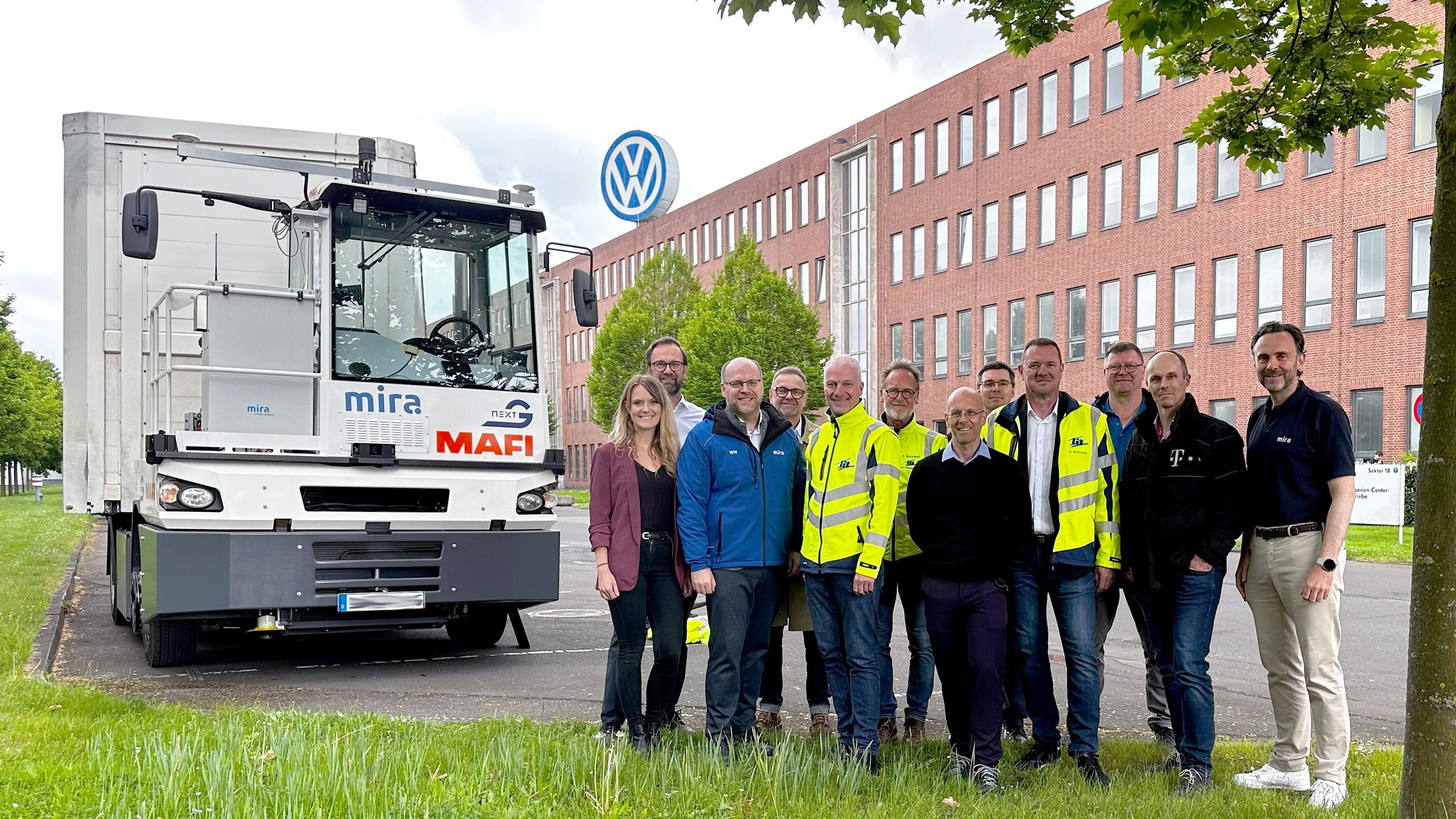
What was just a vision yesterday is becoming a reality today: MIRA, along with Volkswagen and the L.I.T. Group, has made a significant step towards industry applied teleoperation. At Volkswagen’s components plant in Kassel, a remote-controlled terminal tractor was tested for the first time. The test took place on the factory grounds and on a connecting road in Baunatal.
This project shows how combining a vehicle, a digital control center, and secure connectivity — and how teleoperation can help make logistics processes more efficient and flexible in the future.
From the plant premises onto the road
We're testing a MAFI T 230 terminal tractor that has been equipped both with the MIRA teleoperation kit and a retrofitted drive-by-wire system from our partner Arnold NextG. The vehicle was controlled entirely from a control station at the Volkswagen plant in Kassel via public mobile networks. The test route included both the inside of the plant as well as public roads.
Teleoperation for the logistics of tomorrow
Industrial logistics has its share of challenges. Increasing transport costs combined with a growing shortage of skilled drivers require new ways to manage this situation. At the same time, logistics processes need to be organized in a flexible and efficient way.
That's where teleoperation can be a real game changer.
Through remote control, vehicles can be operated from a control station, no matter where the vehicle and the station is, respectively. This reduces downtime and waiting times for drivers, allowing for more flexible scheduling of operations.
For MIRA, this means that teleoperation unlocks new possibilities for deploying vehicles where they're needed, while the vehicle can be operated from a completely different location.
This isn't about removing human labor. Instead, teleoperation combines the skills of much needed qualified drivers with the capabilities and flexibility of digital technologies and modern communications.
Making smart connections between people and technology
A key part of the project is the potential for new and inclusive work models.
In the future, an accessible control station could also let employees with physical limitations safely operate vehicles without being exposed to the physical strain of traditional driving operations. This helps keep valuable experience in-house and creates new career opportunities.
This makes it clear: Digital logistics can do more than just change processes. It can also create new types of work.
From testing to daily operations
For MIRA, the project in Kassel is another important step from pilot operation toward industrial application and daily operations.
Together with Volkswagen and the L.I.T. Group, MIRA is gathering important insights under real world conditions, relevant for evaluating possible daily operations - as well as for potential deployments at other Volkswagen locations in the future.
L.I.T. Group contributes its extensive experience in logistics at the Kassel site. The company has been handling the plant's truck shuttle services since the logistics center opened in 2012.
Having the right mix of tech know-how and hands-on logistics experience is key. After all, innovative technology must prove itself in real-world operations.
Jointly applying innovation
The project at the Volkswagen site in Kassel shows how companies can put new technology into practice by working together.
Volkswagen brings its know-how in industrial applications and plant logistics. L.I.T. Group contributes its operational logistics expertise. MIRA provides the cutting-edge teleoperation technology.
This creates a real-world testing scenario that provides important insights for developing and scaling the technology.
At the end of the day, real innovation doesn't happen in a lab — it proves itself on the ground in daily operations.
The trial in Kassel is therefore not the end of a project, but another step towards a new generation of flexible, digital, and people-centered logistics.